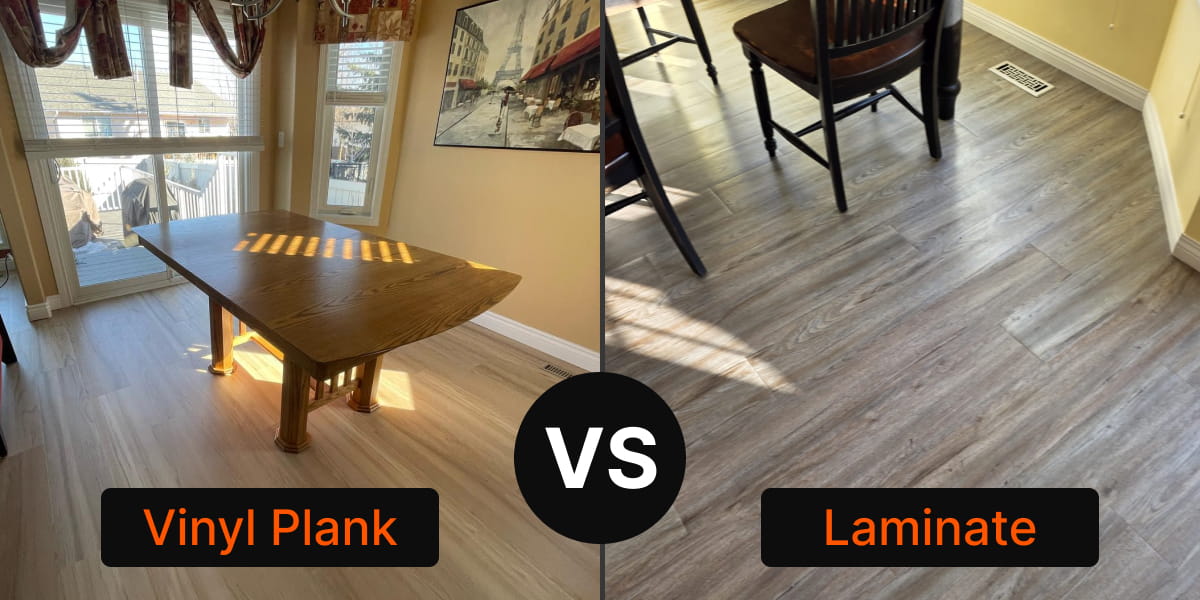
Vinyl and laminate are the two most popular flooring options for Alberta homeowners right now. Both look like real wood, both are affordable, and both are relatively easy to install. So what’s the actual difference — and which one makes more sense for your home?
The short answer: it depends on the room, your lifestyle, and how much moisture your floors are likely to encounter. Here’s a practical breakdown.
What Are We Actually Comparing?
Before diving in, let’s clarify what these materials are.
Luxury Vinyl Plank (LVP) is made entirely from synthetic materials — typically a PVC or SPC (Stone Plastic Composite) core with a printed design layer and a protective wear layer on top. It is 100% waterproof.
Laminate flooring uses a core made from high-density fiberboard (HDF) — essentially compressed wood fibers. On top of that sits a photographic layer that mimics wood grain, covered by a hard melamine wear layer. Laminate is water-resistant, but not waterproof.
This core difference — synthetic vs. wood-based — is what drives most of the practical distinctions between the two.
Why Alberta’s Climate Matters
Alberta’s weather creates specific challenges for flooring that don’t exist in milder climates.
Dry winters. When outdoor temperatures drop to -25°C or lower and furnaces run constantly, indoor humidity can fall below 20%. That’s tough on any material with wood content. Low humidity causes the HDF core in laminate to contract, which can lead to gaps at the seams over time. Vinyl, being fully synthetic, is far less affected by these swings.
Snowmelt and the mudroom problem. Boots, slush, salt, and sand get tracked into Alberta homes for roughly five months of the year. Entryways, mudrooms, and back doors are constantly wet. For these areas, vinyl’s waterproof construction is a clear advantage. Laminate can handle a quick wipe-up, but standing water that reaches the seams can cause the core to swell and warp.
Chinook temperature swings. In Calgary and southern Alberta, Chinook winds can push temperatures up by 20–30°C in a matter of hours. Rapid shifts in temperature and humidity put stress on flooring materials. Rigid-core vinyl (SPC) tends to handle this well because its composition doesn’t absorb moisture.
Basement moisture. Many Alberta homes have finished basements, and concrete subfloors can release moisture vapor. Vinyl is generally the safer choice here because it won’t react to that moisture. Laminate can work in a basement with proper vapor barrier installation, but there’s always more risk involved.
Where Laminate Holds Its Own
It’s not all one-sided. Laminate has genuine strengths that matter, especially in certain rooms.
Scratch resistance. Laminate’s hard melamine surface layer is tougher against fine scratches than vinyl. If you have large dogs, laminate with an AC4 or AC5 durability rating handles claw marks well. Vinyl is softer on the surface, so it can pick up scratches from sharp objects more easily — though dents and impact damage are actually less of a concern on vinyl.
Appearance. Both materials have improved dramatically, but laminate tends to offer slightly more realistic wood texture and depth. Its thicker construction (usually 8–12 mm) allows for deeper embossing and more pronounced grain patterns. Premium LVP has closed the gap, but in a side-by-side comparison, many people still prefer the look and feel of laminate.
Underfoot feel. Laminate feels firmer and more solid, which some homeowners prefer. It has a rigidity that gives it a more “substantial” feel compared to vinyl, which tends to be softer and more flexible underfoot.
Cost. Pricing is comparable — both typically fall in the $2–$4 per square foot range for quality residential products. Laminate can be slightly cheaper at the entry level, though premium options in both categories push higher.
Where Vinyl Has Clear Advantages
Water and moisture. This is vinyl’s biggest selling point. It is fully waterproof. In kitchens, bathrooms, laundry rooms, basements, and entryways — anywhere water or humidity is a regular factor — vinyl is the more reliable choice.
Temperature stability. Vinyl doesn’t expand and contract with humidity changes the way laminate does. In Alberta’s climate, this translates to fewer gaps, less buckling, and fewer callbacks after installation.
Sound. Laminate has a tendency to produce a hollow, “clicky” sound when walked on. Vinyl is naturally quieter. Both benefit from quality underlayment, but vinyl starts with an advantage in noise reduction.
Comfort in cold weather. Vinyl generally feels warmer underfoot than laminate during Alberta winters. It doesn’t conduct cold from the subfloor as readily, especially when installed with a built-in or separate underlayment.
Room-by-Room Recommendations for Alberta Homes
| Room | Recommended | Why |
|---|---|---|
| Basement | Vinyl (LVP) | Waterproof, handles concrete moisture, stays warmer |
| Kitchen | Vinyl (LVP) | Resistant to spills, splashes, and appliance leaks |
| Bathroom / Laundry | Vinyl (LVP) | Constant humidity and water exposure |
| Entryway / Mudroom | Vinyl (LVP) | Handles snow, salt, and slush without damage |
| Living Room | Either | Laminate for appearance; vinyl for quieter, warmer floors |
| Bedrooms | Either | Both work well in dry, low-traffic spaces |
| Home Office | Laminate or Vinyl | Personal preference — laminate feels more solid |
Installation Considerations
Both vinyl and laminate use click-lock systems and can be installed as floating floors. But there are a few things worth noting for Alberta conditions:
- Acclimation. Both materials should sit in the installation room for at least 48–72 hours before installation. This is especially important in winter, when flooring delivered from a cold warehouse needs time to reach room temperature. Installing cold vinyl can lead to expansion issues later; installing cold laminate increases the risk of cracking.
- Subfloor prep. This is the step that makes or breaks a flooring job. In older Alberta homes, uneven subfloors are common. Laminate is less forgiving of imperfections — bumps and dips translate into noise and movement underfoot. Vinyl, particularly flexible options, can tolerate minor irregularities better, though SPC vinyl also benefits from a level surface.
- Expansion gaps. Both materials need room to expand and contract. In Alberta’s climate, slightly larger gaps (around 3/8″ instead of 1/4″) are advisable, especially for winter installations when materials are contracted.
Lifespan and Long-Term Value
Laminate typically lasts 10–20 years depending on quality, traffic, and maintenance. Vinyl tends to last 15–25 years. In Alberta’s climate, vinyl’s moisture resistance often gives it an edge in longevity because the most common cause of premature flooring failure here is moisture-related damage — not surface wear.
Neither material can be refinished. When it’s worn out, it gets replaced. This is a point where both fall short of hardwood, but the lower upfront cost offsets that for most homeowners.
Environmental Considerations
Laminate uses wood by-products in its core, which gives it a smaller environmental footprint in some respects. Vinyl is fully synthetic (PVC-based) and harder to recycle. However, if vinyl lasts longer and needs fewer replacements in your specific environment, the gap narrows. Many manufacturers now offer low-VOC versions of both materials.
So, Which Should You Choose?
Choose vinyl if:
- You’re installing in a basement, kitchen, bathroom, or entryway
- Moisture is a concern in your home
- You want a quieter, warmer floor
- You prioritize longevity in Alberta’s climate
Choose laminate if:
- You want the most realistic wood look at a lower price
- The room is dry and climate-controlled (living rooms, bedrooms)
- Scratch resistance from pets is a top priority
- You prefer a firmer feel underfoot
For many Alberta homes, the practical answer is to use both: vinyl in moisture-prone areas and laminate (or hardwood) in the main living spaces. There’s no single right answer — just the right answer for each room.
At Northedge Flooring, we install both vinyl and laminate flooring across Edmonton and surrounding communities. If you’re unsure which material suits your home, we can assess your subfloors, discuss your lifestyle, and help you make a practical choice. Contact us for a free in-home estimate.