
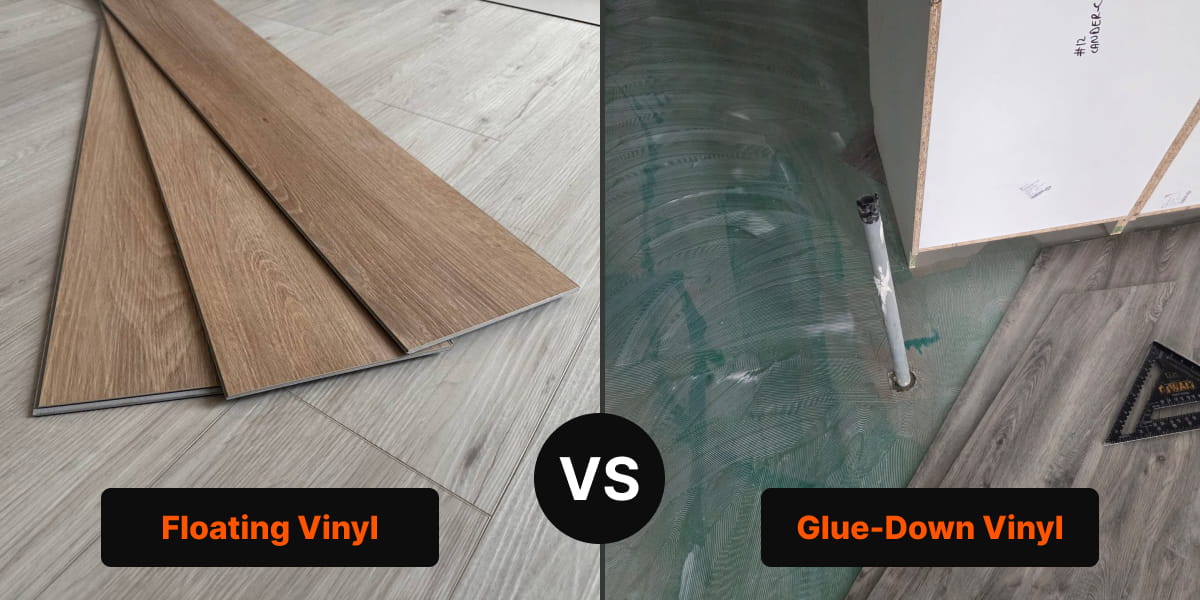
Once you’ve decided on vinyl flooring, there’s a second decision that matters almost as much as the product itself: how it gets installed. Vinyl can be installed two main ways — as a floating floor that clicks together and rests on top of the subfloor, or glued directly down to it.
It’s an easy decision to overlook. The planks can look identical either way. But the installation method changes how the floor feels underfoot, how it handles temperature swings, how it performs in large or busy rooms, and how easy it is to repair years later. This guide explains how each method works, where each one performs best, and how to decide which is right for your space.
First, Clearing Up the Terms
There’s some confusion worth sorting out before going further, because the words get used loosely.
Floating describes how the floor sits — it rests on top of the subfloor as one connected sheet, not attached to it. Most floating vinyl uses a click-lock system, where each plank’s edges snap into the next. For the purposes of this article, “floating vinyl” and “click-lock vinyl” mean the same thing: a floor that locks together and is not bonded to the subfloor.
Glue-down describes a floor where each plank is adhered directly to the subfloor with a vinyl-specific adhesive. The planks don’t connect to each other — they connect to the floor underneath.
Both methods can use the same quality of vinyl, the same wear layers, and the same wood-look or stone-look finishes. The visible surface can be identical. The difference is entirely in how the floor is attached — or not attached — to what’s underneath.
How Each Method Works
Understanding the basic mechanics makes the rest of the decision much clearer.
A floating floor moves as one piece. Vinyl expands slightly when it warms up and contracts when it cools. A floating floor is designed to handle this by moving as a single connected sheet. To allow that movement, the installer leaves a small expansion gap — usually around 1/4 inch — between the floor and every wall, doorway, and fixed object. The gap gets hidden under baseboards or quarter-round, so it doesn’t show. As the floor warms and cools through the year, the whole sheet shifts slightly within that gap.
A glue-down floor doesn’t move. Each plank is bonded to the subfloor. The adhesive holds every plank in place individually, so the floor can’t shift, expand, or contract as a sheet. There’s no expansion gap because there’s no sheet movement to accommodate. The trade-off is that the bond is permanent — the floor is committed to the subfloor for its lifespan.
That single difference — moves as a sheet versus bonded in place — explains almost every practical advantage and disadvantage that follows.
Floating Vinyl: Strengths and Limitations
Where floating vinyl performs well
Faster, simpler installation. No adhesive, no curing time, no rolling. The room is usually ready to walk on much sooner.
More forgiving over imperfect subfloors. A floating floor’s rigid planks bridge minor dips and high spots in the subfloor. The subfloor still needs to be reasonably flat, but small imperfections are less likely to show.
Easier to repair. If a plank is damaged, a floating floor can often be opened up to that spot and the single plank replaced. The floor comes apart the way it went together.
Easier to remove later. Because it isn’t bonded down, a floating floor can be lifted and even reinstalled elsewhere. This makes it appealing for spaces that may be renovated again, or for homeowners who want flexibility.
Slightly softer and warmer underfoot. Floating floors are usually installed with an underlay, which adds a small amount of cushioning and warmth.
Where floating vinyl struggles
Movement in large open areas. A floating floor moves as one sheet. The larger that sheet, the more total movement it has to manage. In very large open spaces, this can lead to visible rippling or planks separating at the seams.
Sensitivity to temperature swings. Because it expands and contracts, a floating floor is more affected by heat than a glue-down floor. Rooms with strong direct sunlight or large windows put more stress on a floating installation.
A hollow sound is possible. Without quality underlay and a flat subfloor, a floating floor can sound slightly hollow underfoot. Good installation reduces this, but it’s a known characteristic.
Heavy furniture can cause problems. Very heavy items — large appliances, full bookcases, pianos — can pin a floating floor in place. When one part of the sheet can’t move and the rest expands, the result can be buckling or separated seams.
Glue-Down Vinyl: Strengths and Limitations
Where glue-down vinyl performs well
Maximum stability. Bonded to the subfloor, a glue-down floor doesn’t shift, ripple, or develop gaps over time. This is its core advantage.
Better for large open spaces. Because the floor doesn’t move as a sheet, there’s no practical size limit. Large open-concept main floors and commercial spaces are well suited to glue-down.
Handles temperature swings better. A bonded floor isn’t expanding and contracting as a sheet, so direct sunlight, large windows, and temperature changes have far less effect.
Better with heated floors. Glue-down generally handles the temperature cycling of radiant in-floor heating better than floating systems, many of which have restrictions on use over radiant heat.
Solid underfoot, no hollow sound. With no air gap or underlay between the plank and the subfloor, a glue-down floor feels firm and quiet.
Stays put under heavy furniture and rolling loads. Heavy appliances, office chairs, and carts don’t cause the movement problems they can with floating floors.
Where glue-down vinyl struggles
Demands a very flat, well-prepped subfloor. A glue-down floor follows the subfloor exactly. Any dip, bump, or imperfection underneath can show through or telegraph to the surface. Subfloor preparation is more critical and often more involved.
More complex installation. Adhesive has to be spread evenly, planks placed within the adhesive’s working time, and the floor rolled to bond properly. There’s also adhesive curing time before the room is back in use.
Harder to repair. Replacing a damaged plank means removing it from the adhesive and cleaning the subfloor before bonding a new one — more involved than swapping a click-lock plank.
Permanent. A glue-down floor is committed. Removing it later is a bigger job than lifting a floating floor.
When Floating Vinyl Is the Wrong Choice
Most guides present floating vinyl as the easy default. It often is a good choice — but there are specific situations where glue-down is clearly the better option, and it’s worth being honest about them.
Large open-concept spaces. If you’re flooring a large continuous area without doorways or transitions to break it up, a floating floor has a lot of sheet movement to manage. Glue-down avoids the rippling and seam-separation risk entirely.
Rooms with strong direct sunlight. South-facing rooms, sunrooms, and spaces with large windows heat up significantly. A floating floor expands under that heat. Glue-down stays stable.
Spaces with very heavy furniture or appliances. Where heavy loads will pin parts of the floor in place, glue-down removes the buckling risk that comes from a floating sheet being partially held down.
Over radiant in-floor heating. Glue-down is generally the safer pairing. If you have or plan radiant heat, check the specific product’s rating — many floating systems have limitations here.
High-traffic commercial settings. Retail, offices, and rental units benefit from the durability and stability of a bonded floor that won’t shift under constant use.
The Edmonton Factor
Installation method matters more in Edmonton than in milder climates, and it comes down to one thing: temperature and humidity swings.
Edmonton moves from -30°C winters to +30°C summers, and indoor humidity drops below 25% from December through March before climbing again in summer. Vinyl responds to those swings by expanding and contracting. A floating floor has to manage all of that movement as a connected sheet, which is why proper expansion gaps and correct acclimation matter so much here. Done correctly, floating vinyl performs well in Edmonton homes — most residential installs are floating, and they hold up fine. But the margin for installation error is smaller than in a stable climate.
Glue-down sidesteps the movement question. A bonded floor isn’t expanding and contracting as a sheet, so Edmonton’s seasonal swings have much less effect. This is part of why glue-down is common in larger spaces, sun-exposed rooms, and commercial settings here.
For most Edmonton homes — standard room sizes, normal furniture, no radiant heat — a properly installed floating floor is a sound choice. For large open main floors, sunrooms, or commercial spaces, glue-down’s stability is worth the extra installation effort.
How to Decide: A Few Questions
Four questions usually point clearly to one method or the other:
- How large and open is the space?
Standard rooms and spaces broken up by doorways → floating works well. Large continuous open-concept areas → glue-down. - How much direct sun does the room get?
Normal lighting → floating is fine. Strong direct sunlight, large south-facing windows, or a sunroom → glue-down. - Is there radiant in-floor heating?
No → either method works. Yes → glue-down is the safer pairing; check product ratings carefully. - Is it a home or a commercial space?
Residential with normal traffic → floating is usually the practical choice. Commercial, retail, rental, or very high-traffic → glue-down’s durability and stability are worth it.
If your answers point in different directions — say, a large open space in a home with normal sun and no radiant heat — the size factor usually wins, and glue-down is the safer call.
Side-by-Side Comparison
| Factor | Floating (Click-Lock) | Glue-Down |
|---|---|---|
| Attachment | Rests on subfloor, not bonded | Bonded directly to subfloor |
| Installation speed | Faster, no curing time | Slower, adhesive needs curing |
| Subfloor prep | More forgiving of minor imperfections | Requires a very flat subfloor |
| Stability | Moves as a sheet | Does not move |
| Large open areas | Movement can cause rippling | Performs well at any size |
| Direct sunlight / heat | More affected by expansion | Stays stable |
| Radiant heat | Often restricted — check product | Generally the better pairing |
| Heavy furniture | Can pin the floor and cause buckling | Stays put |
| Sound underfoot | Can feel slightly hollow | Firm and quiet |
| Repairs | Single planks easier to replace | More involved |
| Removal later | Can be lifted and reused | Permanent |
| Best suited to | Standard residential rooms | Large spaces, commercial, sun-exposed rooms |
Final Thoughts
Neither method is better than the other in every situation — they’re suited to different conditions. Floating vinyl is faster to install, more forgiving over imperfect subfloors, and easier to repair or remove, which makes it a sound choice for most standard residential rooms. Glue-down vinyl is more stable, handles large open areas and temperature swings better, and is the stronger choice for commercial spaces, sun-exposed rooms, and installations over radiant heat.
The product on top can be identical. The right installation method depends on the room: its size, its sun exposure, how it’s heated, and how hard it will be used.
If you’re weighing the two for a specific space, Northedge Flooring offers free in-home consultations across Edmonton and the surrounding area. We’ll look at the room’s size, layout, sun exposure, and subfloor, and recommend the installation method that fits the conditions — not just the one that’s quickest to install.