
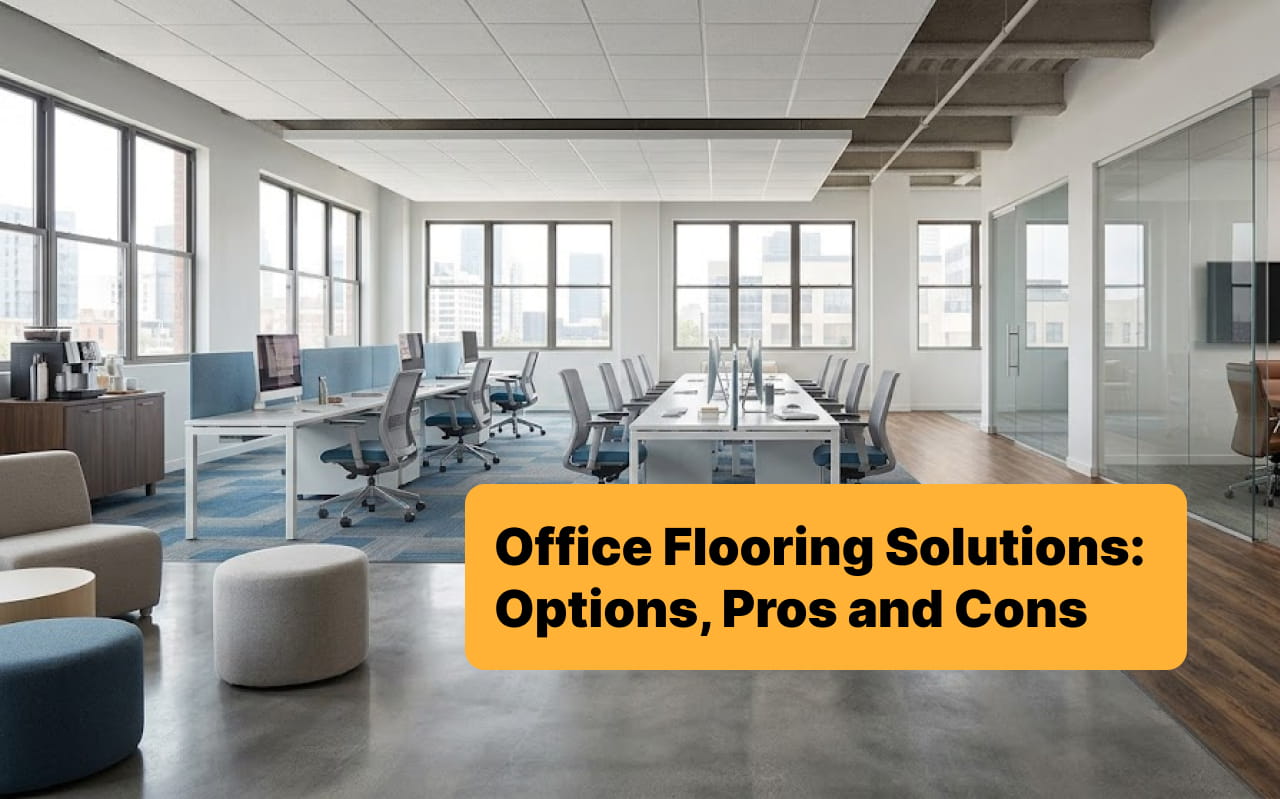
Office floors take a specific kind of abuse. Rolling chairs grinding across the same square metre eight hours a day. Foot traffic through corridors from morning to evening. Coffee spills near the kitchen. Wet boots in the entry from November through March. And underneath all of it, the floor has to keep the space quiet enough that people can actually work.
That combination is why office flooring decisions rarely come down to one material. Most offices end up using two or three, matched to how each zone actually gets used. This article covers the main options, what each one does well, where each one falls short, and how to think about which zones need what.
What Makes Office Flooring Different
Four things drive the choice in an office, and they’re not the same things that matter in a home.
Traffic is constant and concentrated. Corridors and reception see hundreds of passes a day. Desk areas get rolling chairs, which are harder on flooring than foot traffic because the load is concentrated on small casters moving over the same spots repeatedly.
Noise matters more than most people plan for. Open-plan offices with hard floors get loud fast. Footsteps, chair movement, and conversation all bounce off hard surfaces. Sound is one of the most common complaints in offices that chose flooring purely on looks and durability.
Maintenance is a recurring line item, not a weekend chore. Whatever goes down gets cleaned daily or near-daily for the life of the floor. A material that needs waxing, polishing, or specialized products costs more over five years than one that just needs a mop.
Downtime costs money. Every day the office is closed or partially closed for flooring work is lost productivity. Materials that install fast and can be phased across a weekend have a real advantage.
Luxury Vinyl Tile and Plank (LVT/LVP)
Commercial-grade LVT is the most-installed office flooring we work with, and for most offices it’s the right starting point.
The pros: it’s durable enough to handle rolling chairs and corridor traffic when the wear layer is specified correctly. It’s waterproof, so kitchen spills and wet boots aren’t a problem. It cleans with a mop and standard commercial cleaner, no waxing or polishing. It comes in convincing wood and stone looks, so it reads as professional rather than industrial. And individual tiles can be lifted and replaced if one gets damaged, without touching the rest of the floor.
The cons: it reflects sound. In an open-plan office or a conference room, LVT alone will make the space noisier than carpet. It usually needs acoustic help from ceiling panels, wall treatments, or area rugs. It also needs a genuinely flat subfloor, especially for glue-down installations, because any dip or bump underneath telegraphs through to the surface.
The specification that matters most is the wear layer. For a small office with light traffic, 20 mil is usually enough. For corridors, reception, and anywhere with steady daily use, 28 mil is the safer call. Residential LVT with a 6 or 12 mil wear layer looks identical in a showroom and will show traffic patterns within a year or two in an office.
Glue-down installation is generally preferred over click-lock in offices. Rolling chairs and heavy furniture can shift a floating floor over time, and glue-down doesn’t move.
Carpet Tile
Carpet tile has been the office default for decades, and the reasons still hold up.
The pros: it’s the best acoustic performer of any office flooring by a wide margin. It absorbs footstep noise, chair movement, and conversation, which makes a real difference in open-plan spaces and call centres. It’s comfortable underfoot for people standing at sit-stand desks. Individual tiles can be swapped when one gets stained or worn, which is the main advantage over broadloom. And it hides dust and minor dirt better than a hard surface does.
The cons: it stains, and stains are permanent unless the tile gets replaced. It wears faster than LVT in high-traffic zones. It holds dust and allergens more than hard surfaces, which matters in some workplaces. And it needs vacuuming, not just mopping, which is a different cleaning routine.
The rating matters here the same way the wear layer matters for vinyl. Light commercial carpet tile in a busy corridor will look worn within a couple of years. Heavy commercial rating with a low, dense loop pile is what handles rolling chairs and constant traffic.
Polished Concrete
Polished concrete works in specific kinds of offices, and not at all in others.
The pros: it’s the most durable option available and lasts decades with almost no maintenance beyond sweeping and periodic resealing. It handles rolling loads and heavy furniture without any wear. It suits modern, industrial, or creative office aesthetics well. And if the building already has a decent slab, there’s no new material to buy.
The cons: it’s loud. Concrete is dense and sound-reflective, which makes open-plan echo problems significantly worse. It’s hard and cold underfoot, which staff who stand all day will notice. It only works if the existing slab is in good condition, because polishing reveals whatever’s already there. And the finish level matters for slip resistance, especially near entrances where wet boots come in.
Polished concrete makes the most sense in creative studios, tech offices, breweries with office space attached, and anywhere the industrial look is intentional rather than a compromise.
Engineered Hardwood
Wood shows up in executive offices, boardrooms, and reception areas where the look carries weight with clients.
The pros: it reads as premium in a way no other material quite matches. It’s warm underfoot. In a client-facing space, it signals a certain level of investment.
The cons: it scratches, and rolling chairs will damage it without chair mats. It’s the most expensive option on this list. Refinishing is disruptive and closes the space. It’s not waterproof, so it doesn’t belong near kitchens or entrances. And acoustically it’s closer to LVT than carpet.
Engineered handles humidity better than solid hardwood, which matters in Edmonton where indoor humidity swings from under 25% in winter to much higher in summer. If wood is going into an office here, engineered is the only version worth considering.
Broadloom Carpet
Roll carpet still gets specified occasionally, usually for cost reasons.
The pros: it’s cheaper per square foot than carpet tile. It has no visible seams, so it can look cleaner in a large open area.
The cons: it can’t be spot-replaced. One coffee spill or one worn traffic lane means replacing the whole room. It’s less durable than carpet tile because it lacks the backing structure. And fitting it around office layouts generates a lot of offcut waste.
For most offices, carpet tile is the better version of the same idea. The upfront saving on broadloom disappears the first time a section needs replacing.
How Offices Actually Combine These
Very few offices use one material throughout, and the ones that do usually regret it in one zone or another. The common approach is matching material to zone.
Reception and lobby set the first impression and take the worst of the winter traffic. LVT or tile handles this well. Some offices use polished concrete or engineered wood here for the look, with proper entry matting to catch salt and slush.
Corridors get constant foot traffic. LVT with a 28 mil wear layer is the standard answer. Carpet tile works but wears faster in these lanes.
Open-plan desk areas are where acoustics matter most and rolling chairs do the most damage. This is the zone where carpet tile earns its place. If the design calls for LVT here, plan for acoustic ceiling treatment and area rugs, because the noise will otherwise become a complaint.
Meeting rooms and boardrooms need to sound good for calls and video meetings. Carpet tile is the safest choice. If the room uses LVT or wood for appearance, a large area rug under the table does most of the acoustic work.
Kitchens and breakout areas see spills constantly. LVT is the practical answer. Carpet in a kitchen zone is a recurring stain problem.
The Edmonton Factor
Two local realities affect office flooring here more than in milder climates.
Entryways take a beating from November through March. Salt, sand, slush, and de-icer chemicals come through the door dozens of times a day. Whatever flooring is at the entrance takes the worst wear in the building. Multiple zones of walk-off matting, followed by tile or a high-wear-layer LVT, is what actually protects the rest of the floor. Offices that skip this end up replacing reception flooring years earlier than the rest of the space.
The other thing is slab condition. A lot of Edmonton’s office inventory sits in older buildings where the concrete slab needs moisture testing and levelling before anything goes down. Glue-down LVT in particular follows the slab exactly, so any unevenness underneath shows up on the surface. Testing the slab first is cheaper than finding out afterward.
Comparison at a Glance
| Material | Durability | Acoustics | Maintenance | Best Zones |
|---|---|---|---|---|
| Commercial LVT (28 mil, glue-down) | High | Poor | Low, mop only | Corridors, reception, kitchens |
| Carpet tile (heavy commercial) | Moderate | Excellent | Moderate, vacuum + spot clean | Open plan, meeting rooms, private offices |
| Polished concrete | Highest | Poor | Very low | Creative studios, industrial-style offices |
| Engineered hardwood | Moderate | Poor | Higher, needs chair mats | Executive offices, boardrooms, reception |
| Broadloom carpet | Low | Excellent | Moderate, no spot replacement | Rarely the right call |
Final Thoughts
The right office floor is usually two or three materials, not one. Carpet tile where noise and comfort matter, LVT where traffic and spills happen, and something with presence in the spaces clients see. Trying to solve every zone with a single product means one zone always loses.
Start by mapping how the space actually gets used, then pick materials for each zone, then choose the look from within what works. Doing it the other way around, picking the look first, is how offices end up with beautiful floors that are too loud to work in or worn out in three years.
If you’re planning an office fit-out or refresh in Edmonton or the surrounding area, Northedge Flooring works on commercial installations across the region. We can walk the space, check the slab, talk through how each zone gets used, and put together a specification that fits the building and the way your team works.