Commercial flooring is a different problem than residential flooring. The wear is heavier, the consequences of a wrong choice are more expensive, and the people walking on the floor aren’t the ones who picked it. A floor that performs fine in a home might be ruined within a year in a busy restaurant or office. The questions that matter are different too: not just “how does it look,” but how it handles traffic, what it costs to keep clean, how loud it is, whether it meets accessibility requirements, and how long the business is closed during installation.
This guide walks through what actually matters when picking flooring for an office, retail space, restaurant, healthcare facility, or any other commercial setting. It’s written for business owners and property managers who need a practical answer, not a marketing pitch.
Why Commercial Flooring Is a Different Problem
A few realities shape every commercial flooring decision.
Traffic is heavier and constant. A retail space sees hundreds of foot passages a day. A restaurant sees that plus rolling carts and chairs being dragged. A medical facility adds wheelchairs and equipment. Residential floors aren’t designed for that kind of cycling, and using them in commercial settings is one of the most common mistakes we see.
Liability is a real factor. A slip-and-fall in a business can result in claims that exceed the cost of the floor by orders of magnitude. Slip resistance isn’t a “nice to have” — it’s a financial risk-management decision.
Maintenance becomes a recurring cost. Cleaning a commercial floor isn’t a weekend chore. It’s a daily or near-daily expense that adds up over the lifespan of the floor. A material that’s cheaper upfront but harder to maintain often costs more over five years than a more expensive material that cleans easily.
Downtime hurts revenue. Every day a business is closed for installation is lost revenue. Installation time and how the work can be phased matters more in commercial than it ever does in a home.
The floor is part of the brand. A high-end retail boutique with builder-grade laminate sends a message to customers, whether you intend it or not. A casual coffee shop with marble looks pretentious. Flooring fit matters.
The Five Things That Actually Matter
When evaluating any commercial flooring option, these are the five factors worth understanding before signing anything.
- Wear layer (for vinyl) or wear rating (for laminate, carpet, tile). This is the single biggest predictor of how long a commercial floor will last. For vinyl, wear layers are measured in mils. Twenty mil handles light commercial traffic — small offices, boutique retail. Twenty-eight mil is the sweet spot for restaurants, mid-sized retail, and schools. Forty mil or higher is what we’d specify for high-traffic environments like big-box stores, hospitals, or airports. For laminate, the AC rating system runs from AC1 (residential) to AC5 (heavy commercial). Most commercial settings should be AC4 minimum.
- Slip resistance (DCOF rating). The Dynamic Coefficient of Friction measures how slip-resistant a surface is when wet. ADA accessibility guidelines reference a minimum DCOF of 0.42 for level surfaces. Most quality commercial-grade flooring exceeds this, but it’s worth verifying — especially in entryways, restaurants, healthcare facilities, and anywhere water might be present. Smooth polished tile that looks impressive in a showroom can fail this test entirely.
- Maintenance burden. What’s the daily cleaning routine? Is grout going to need sealing every year? Does the polish need to be reapplied? Carpet tiles need vacuuming and occasional spot cleaning. Polished concrete needs almost nothing. Hardwood needs careful product selection and won’t tolerate aggressive cleaners. Match the maintenance reality to what your staff can actually keep up with.
- Acoustics. Open offices with hard floors get noisy fast. Restaurants where conversations bounce off concrete become uncomfortable. Healthcare facilities have specific requirements around noise control. Carpet tiles, cork, and rubber dampen sound significantly. Tile, polished concrete, and vinyl on a hard subfloor don’t.
- Brand fit. This isn’t about being fancy — it’s about being appropriate. A factory needs a floor that signals industrial competence. A boutique needs one that signals quality. A school needs durable and approachable. Mismatched flooring often gets noticed before any individual product flaw does.
Materials That Work in Commercial Settings
Six categories cover almost every commercial flooring decision we see.
Commercial-grade luxury vinyl plank (LVP or LVT). The most-installed commercial flooring we work with. Waterproof, dimensionally stable, available in wear layers up to 40 mil, and easy to maintain. Glue-down installation is usually preferred in commercial settings because the floor doesn’t shift under wheeled carts, office chairs, or heavy foot traffic. Click-lock floating versions work in smaller commercial spaces but have their limits in large open areas. The right specification matters a lot here; residential vinyl in a commercial space is one of the more common shortcut mistakes.
Porcelain tile. The most damage-resistant option available. Holds up to heavy traffic indefinitely, doesn’t absorb spills, and handles temperature changes without issue. The downsides are real: it’s expensive to install (subfloor needs to be flat and crack-free, grout work is labour-intensive), it’s hard underfoot for staff who stand all day, and the DCOF needs to be verified for wet areas. Textured or matte finishes give much better slip resistance than polished. Porcelain remains the right call for restaurant kitchens, bathrooms, lobbies, and any wet zones.
Polished concrete. Often the right answer for industrial spaces, modern retail concepts, warehouses, and breweries. Almost no maintenance after the initial polish. Very durable. Cold and hard underfoot, which limits where it works. Slip resistance varies dramatically with finish — high-gloss polished concrete can be dangerous in wet conditions, while ground or honed finishes are much safer. Concrete also shows existing slab imperfections, so the slab condition determines whether this is even an option.
Commercial carpet tiles. The go-to for offices where acoustic dampening and comfort matter. Individual tiles can be replaced when stained or worn, which is a significant cost advantage over broadloom carpet. Modular installation also makes phased renovations easier. Modern commercial carpet tiles handle moderate spills well, but they’re not waterproof and shouldn’t be used in restaurants, healthcare wet zones, or entryways with heavy snow tracking. The wear rating matters; light commercial tiles will wear out fast in heavy-use areas.
Rubber flooring. Built for gyms, fitness studios, and industrial workshops. Excellent impact absorption, slip resistance, and durability. The look limits where it works — most professional offices, retail, or restaurants won’t go this direction. But where it fits, nothing else performs comparably.
Commercial-grade hardwood and engineered hardwood. Works in upscale offices, boutique retail, and hospitality spaces where the look matters more than maximum durability. Engineered hardwood handles humidity changes better than solid wood and can be installed over concrete with proper preparation. Both require careful site selection and realistic maintenance expectations. We don’t recommend either for restaurant dining floors with heavy wet traffic, or for facilities expecting heavy rolling loads.
A Quick Guide by Industry
Different industries have different defaults, and these are the patterns we see hold up.
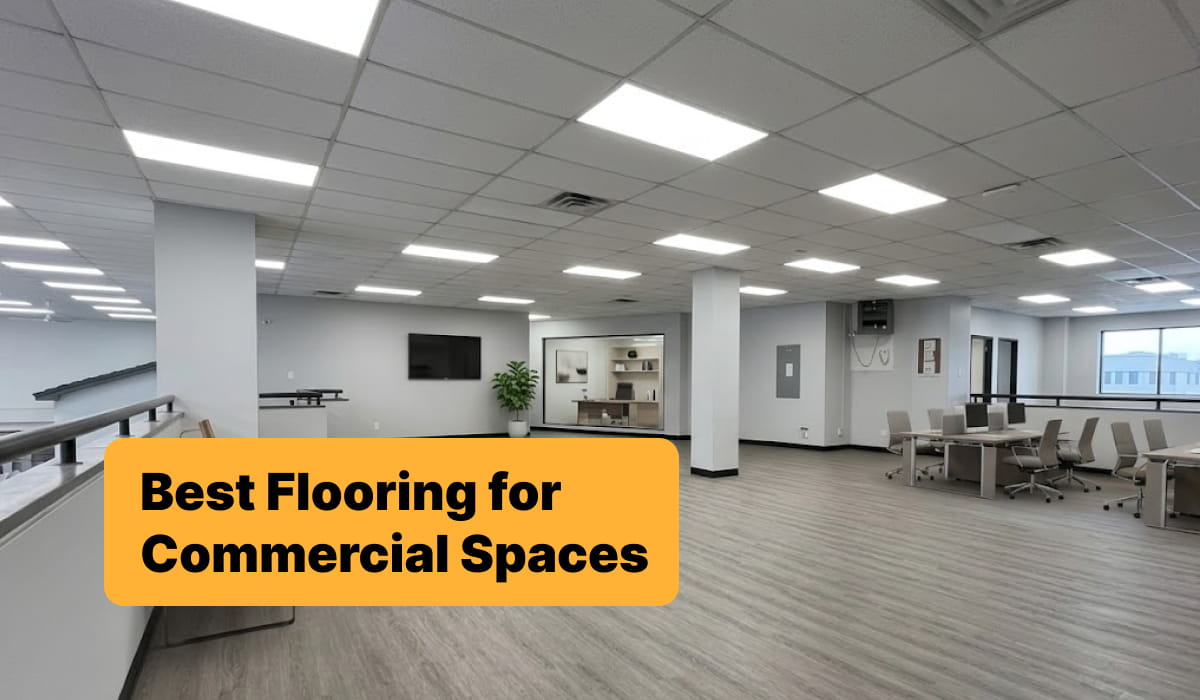
Offices. Commercial-grade LVP in main areas, carpet tiles in private offices and meeting rooms for sound dampening. Twenty to 28-mil wear layer is usually sufficient. If the office has a customer-facing reception or lobby, tile or polished concrete reads more professional than vinyl.
Retail. Commercial LVP at 28 mil minimum handles most retail floor space well. Tile or polished concrete in entryways for snow and salt management. For higher-end retail, porcelain tile or engineered hardwood in central areas signals quality.
Restaurants. Porcelain tile in kitchens, no exceptions. Dining areas can use commercial LVP (28+ mil), engineered hardwood (with realistic maintenance expectations), or porcelain. Slip resistance is critical: DCOF should be verified for the actual installed product, not just the spec sheet.
Healthcare and senior living. Slip resistance, infection control, and acoustic management drive most decisions. Commercial LVP with high DCOF ratings and welded seams works in most patient areas. Carpet tiles work in reception and quiet zones. Glossy and porous surfaces are usually avoided.
Industrial and warehouse. Polished concrete, sealed concrete, or epoxy. Rubber in specific work zones where impact absorption matters.
What to Be Careful With
A few patterns we see go wrong in commercial settings:
Residential vinyl in a commercial space. Lower wear layers (6 to 12 mil) will fail within a year or two under commercial traffic. The same brand often has both residential and commercial product lines that look identical in the showroom but have very different ratings.
Solid hardwood in restaurants. Moisture, spills, and grease damage solid wood faster than most owners expect. Engineered hardwood is a better bet if wood is non-negotiable.
Glossy finishes in entryways. Polished tile or high-gloss vinyl in a commercial entryway is a slip-and-fall claim waiting to happen, especially in winter when wet boots come in constantly.
Broadloom carpet in heavy-use commercial spaces. Single-tile replacement is one of the biggest practical advantages carpet tiles have over broadloom. In any space where stains, spills, or wear are likely, broadloom forces full-room replacement instead of single-tile swaps.
Specifying flooring without checking the subfloor. Concrete slabs in commercial buildings often have moisture, cracks, or unevenness that ruin a new floor within months. Test the slab before specifying the product, not after.
Total Cost of Ownership
A common mistake in commercial flooring is comparing upfront price between options. The real number worth comparing is total cost over the floor’s lifespan.
Three things drive ongoing cost: maintenance, downtime, and replacement frequency.
Maintenance is what you spend keeping the floor clean and functional every day. A floor that needs daily polishing, weekly stripping, or specialized cleaning products adds up fast. A floor that needs nothing beyond regular cleaning costs almost nothing to maintain.
Downtime is what you spend on installation and any future repairs. Replacing damaged sections, refinishing, or repolishing all require closing parts of the business. Materials that allow modular replacement (carpet tiles, sometimes glue-down LVT) reduce this cost significantly.
Replacement frequency is how often the whole floor has to come out. Cheap vinyl with a 6 mil wear layer in a busy retail space might need replacement every three to five years. Commercial-grade vinyl with a 40 mil wear layer might last fifteen to twenty. The upfront difference is often less than the cost of one premature replacement.
Most commercial flooring decisions are better evaluated on a five-to-ten-year horizon than on initial quote alone.
The Edmonton Factor
Two local realities are worth flagging.
Entryway management.
Edmonton winters bring salt, slush, sand, and de-icer chemicals into every commercial entrance. Whatever flooring is installed at the door takes the worst abuse in the building. Walk-off matting, multiple zones of tile or vinyl, and a maintenance plan for wet boots make a real difference in how long the rest of the floor lasts. We’ve seen new installations damaged within a single winter because the entryway wasn’t planned around this.
Concrete slab condition in older commercial buildings.
Many commercial spaces in Edmonton have concrete slabs that need moisture testing, levelling, or both before any flooring goes down. This is especially true in older retail and office buildings. Skipping this step is one of the more expensive ways to ruin a new install.
Common Mistakes We See
Three patterns repeat across commercial flooring projects:
Picking the lowest quote without checking what’s in it. A flooring quote that doesn’t include subfloor prep, removal of the old floor, transitions, baseboards, and disposal is going to grow during installation. Line-item comparison is essential in commercial work.
Underspecifying the wear layer. The product photos look identical between a 12 mil and a 40 mil vinyl. The performance over five years is not identical. Always verify the wear layer matches the traffic level of the space.
Treating flooring like an aesthetic decision first and a functional decision second. A commercial floor needs to perform under traffic, meet liability standards, and clean easily. Looks matter, but they’re third in priority. The right approach is to first list what the floor needs to do, then narrow to the materials that can do it, then pick the look from within that narrow list.
Comparison at a Glance
| Material | Best For | Typical Wear Layer / Rating | Slip Resistance | Acoustic Performance | Maintenance |
|---|---|---|---|---|---|
| Commercial LVP (glue-down) | Offices, retail, healthcare, restaurants (dining) | 20–40 mil | Good with textured surface | Moderate | Low |
| Porcelain tile | Kitchens, bathrooms, lobbies, wet zones | Standard commercial grade | Good with matte/textured finish | Poor | Moderate (grout) |
| Polished concrete | Industrial, modern retail, breweries | N/A | Variable — finish-dependent | Poor | Very low |
| Commercial carpet tiles | Offices, meeting rooms, healthcare quiet zones | Heavy commercial rating | Good | Excellent | Low |
| Rubber | Gyms, workshops, fitness | Heavy commercial | Excellent | Good | Low |
| Engineered hardwood | Boutique retail, upscale offices, hospitality | Commercial-grade finish | Moderate | Moderate | Higher |
Final Thoughts
Commercial flooring done well is a long-term investment that supports the business. Done poorly, it’s a recurring cost that drains revenue through maintenance, replacement, and the occasional liability claim. The right material depends on the specific use case, but the questions that lead to the right answer are the same: how heavy is the traffic, how much liability is involved, how much maintenance can you sustain, what does the space need to sound like, and what does the floor need to communicate to anyone walking in.
If you’re planning a commercial flooring project in Edmonton or the surrounding area, Northedge Flooring works on retail, office, multi-unit, and hospitality installations across the region. We can walk through the space, look at the slab and existing conditions, talk through traffic and maintenance realities, and recommend a specification that fits the building and the business, not a generic product.